|
SUMIDS, Small Unmanned Multi-Domain Systems, are next-generation military unmanned platforms that optimize warfighter situational awareness and signature at the tactical and operational levels. These single-person portable / single-person operable systems function in two or more domains, notably air and land, and comprise both active and passive mechanisms to dramatically extend warfighter capability. In addition to individual systems, the SUMIDS concept comprises constellations of specialized platforms that a warfighter / small unit can deploy and utilize in concert with one another, including marker beacons and pods carried by SUMIDS vehicles. Ed Darack developed the SUMIDS concept based on years of direct observation of warfighters in training and while deployed to combat in Afghanistan and Iraq, as well as historical research, notably detailed studies of missions like Operation Eagle Claw. Darack created the concept and evolved individual SUMIDS for small units, including fire teams, squads, and platoons, and specialized teams including Scout Sniper teams and special operations teams, notably those tasked with special reconnaissance. SUMIDS were developed to be fluidly integrated into in-place and evolving warfighting systems and constructs, synergizing a full spectrum of capabilities at tactical and operational levels. The versatile nature of SUMIDS and SUMIDS constellations allows warfighters to perform a tremendous range of applications, including active and passive building of situational awareness, kinetic applications, cyber applications, MULTI-INT collections applications, meteorological monitoring applications, electronic warfare applications, communications applications, information operations, search and rescue applications, and others.
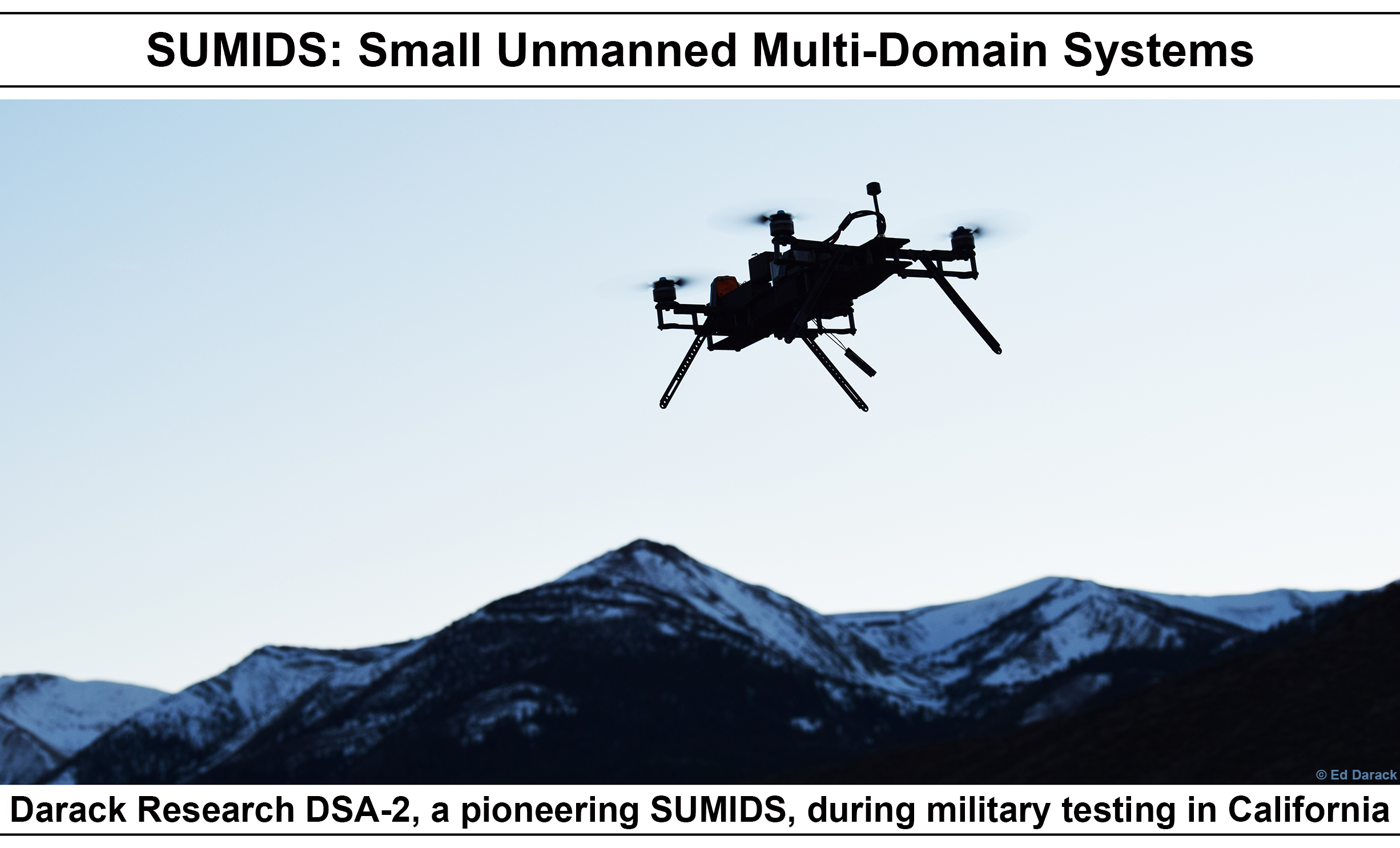
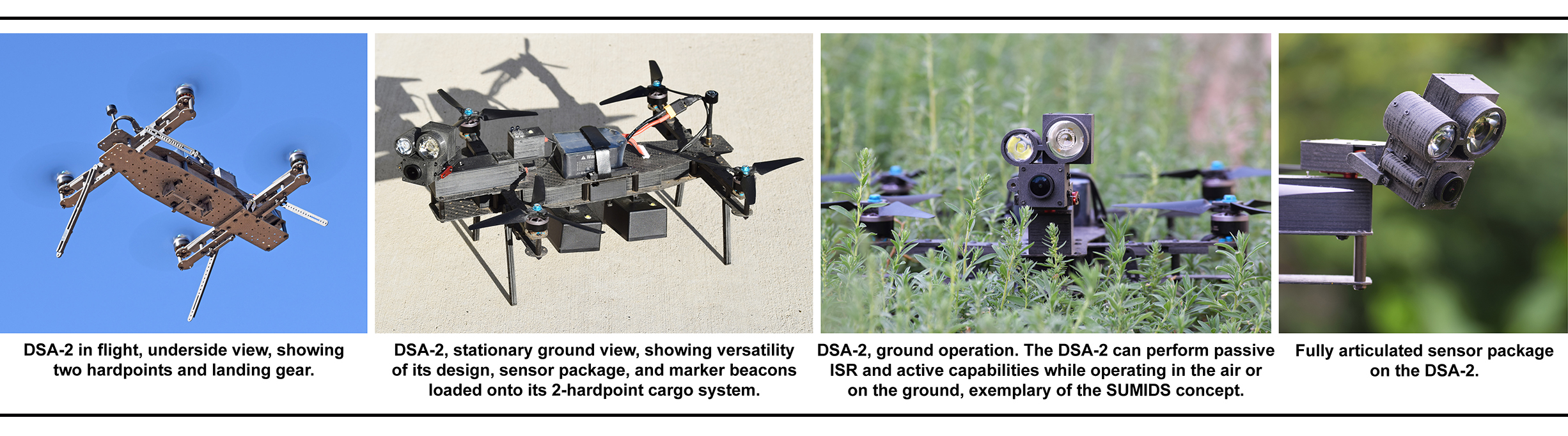
The SUMIDS concept is best exemplified by the Darack Research DSA-2 (Darack Research SUMIDS (Aerial)-2), a quadrotor system that weighs less than 12 pounds total, including controller, spare batteries, and spare componentry (vehicle weight being less than four pounds). The DSA-2 features a form that is easily adaptable (including multiple tie-down points) to specialized applications, a fully articulating situational awareness module mounted atop the craft’s forward extremity, an easily configurable landing gear system, and a 2-point cargo system. An operator can fly the DSA-2 over an area of interest (AOI) and perform aerial ISR (intelligence, surveillance, and reconnaissance) and then land it atop a key terrain feature and either power down or conduct low-power-consumption static ISR from the ground with the fully articulating situational awareness module. The situational awareness module comprises a day / night imager, a laser pointer bore sight mounted to the imager, a high-output visible wavelength illuminator, and a high-output 850-nanometer infrared illuminator. The DSA-2 can also be fitted with self-marking systems, including high-intensity infrared or visible wavelength marker lights. Furthermore, the DSA-2 can deploy up to two individual, remotely activated marker beacons or pods to mark targets or to create landing zones or other designated tactical points. The ability to power the system remotely allows for mission times not in minutes or hours, but in days, where a remote operator can conduct ISR at intervals, and then remotely reposition the DSA-2 as a mission requires, saving energy. The combination of passive ISR systems and active marking and illumination systems allows an individual warfighter to remotely build a tremendous level of situational awareness for all components of an operation at the tactical level and the operational level. This parallels the capabilities of an on-site warfighter using an integrated pointing and illumination module (like a PEQ-16B, which comprises a visible and an infrared laser pointer and a visible and an infrared illuminator). Furthermore, SUMIDS enable this next generation of situational awareness to be built while maintaining optimized signature, engendering a massive evolutionary leap of multi-domain capability for the individual warfighter and small unit.
SUMIDS engender a next-generation level of detailed integration of small and specialized unit capability into greater multi-domain, combined arms architectures. From a covered, signature-optimized position, a small unit can perform persistent surveillance of an AOI or specific target, mark targets, create target reference points (TRPs), and mark landing zones and other tactical locations for other elements in an evolving operation, “painting the battlespace” remotely. SUMIDS further allow remote forward observation, battle damage assessment (BDA), and continued remote situational awareness optimization using onboard active systems like illuminators and laser pointers, as an operation evolves.
Comprehensive SUMIDS Overview (.pdf)
Contact:
Ed Darack: (307) 640-0054 / Email
Darack Research LinkedIn Page
Darack Research Home
|